

Case Study
Team Reset Programme for a team at a government department, Feb-Apr 2026
A team in a government department used a well prepared one-day reset to turn a new structure and strategy into clear, agreed ways of working.
Clarity on how the team works together rose by 14%, perceived effectiveness by 31%, and confidence in handling future challenges by 39%.
Enabling a team to translate structural change and a new strategy into clear ways of working
Client: team at a central government department (confidential)
Following a period of organisational restructuring, the team had reached a natural transition point. A new structure had been implemented, roles and responsibilities had been clarified, and the team was preparing to roll out a new strategy, with a new structure, roles and responsibilities in place.
The team’s senior management team (SMT) wanted to ensure that the changes were reflected in structure and direction, and the way the team worked together day to day. Teamshaper was engaged to design and facilitate a process that would help:
create shared clarity across the team
strengthen coordination between different areas
establish practical ways of working to support delivery.
The work was initiated and supported by the SMT, with the Deputy Director and her leadership group closely involved throughout. The programme was led by Teamshaper’s Associate Trainer Simon Phillips, our strategy and change specialist with experience in helping public sector teams translate organisational change into clear, practical ways of working.
Built upon the team’s context
The programme was designed using direct input from the SMT and a confidential questionnaire with all team members once the restructure and reallocation of roles had been completed, bringing together their multiple perspectives to build a clear and balanced current view of how the team was operating in practice.
This preparation ensured the programme was shaped by the experience of the whole team, rather than relying only on the leadership perspective, and helped build a fuller picture of where things were already working well and where greater clarity would be useful.
The responses showed a team with a strong and positive culture within smaller groups (the original teams before they were merged into one), alongside a clear appetite to work more cohesively across the wider team. There was broad alignment with the new strategy and a shared sense of direction, with many describing success as working as one team across pillars and contributing clearly to collective priorities.
The overall picture closely reflected the SMT’s view of the situation, which provided confidence that there was a strong and accurate understanding of the team’s experience and priorities.
At the same time, there was less consistency in the way work connected across the team, how decisions were understood and how communication flowed. Individuals were generally clear on their own roles, while fewer had a full view of how everything fitted together.
These insights shaped the focus of the workshop.
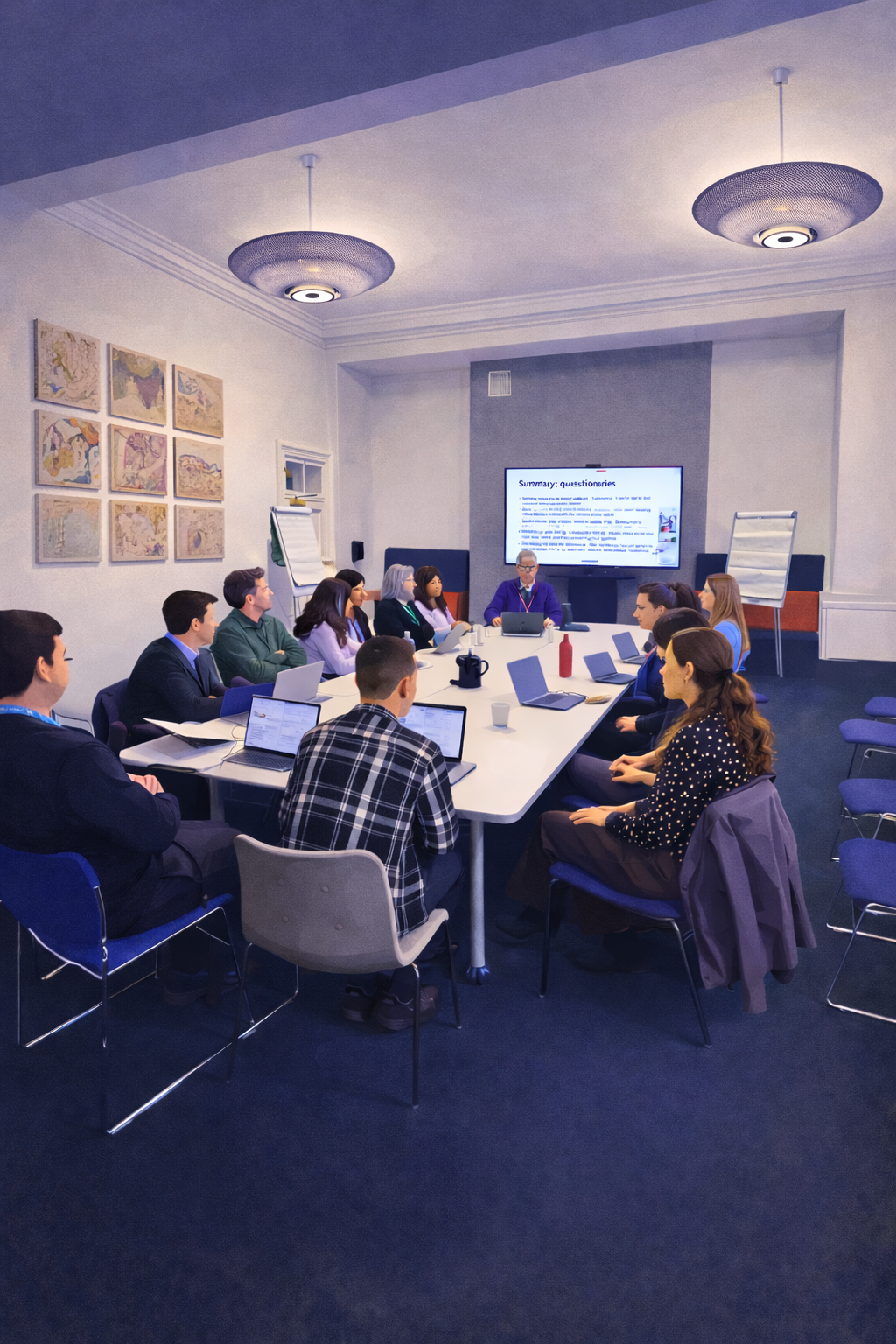
Our approach: a fully experiential working session
With the team spread across multiple locations, bringing everyone together physically for the workshop created a valuable opportunity for the team to work through these questions in a shared space.
The session was designed as a structured working day rather than a traditional workshop format. Participants worked individually, in pairs and in small groups throughout, with no lecture-style delivery. Every part of the day was focused on generating outputs, making decisions and applying them directly to the team’s context.
This approach ensured that the content remained immediately relevant, so participants maintained a high level of energy and engagement across the day.
The work started with devising a shared definition of success and then moved to building a common view of the team’s work, priorities and contribution. From there, the focus shifted to how work moved across the team, including scoping, dependencies and communication routes, before the group translated this into a small set of agreed ways of working.
“Excellent and engaging session that avoids the normal pitfalls of group training that often feel like a long day but this session was engaging the entire time and every minute felt important and useful”
“Team Building from the bottom up”
From clarity to action
By the end of the session, the team had developed:
a shared view of current, evolving and emerging work
greater clarity on how individual contributions connect to whole-team priorities
agreed communication routes and expectations
a consistent approach to ownership, decision-making and coordination
a concise articulation of the team’s purpose
a focused set of priorities where effort would be concentrated
a visible tracker and review rhythm to maintain coordination and follow-through
Each team member was encouraged to identify and commit to a number of actions linked to team priorities, with clear ownership and a commitment to progress these in the following weeks.
These outputs provided a clear and usable reference point for how the team would coordinate work, make decisions and maintain focus in the period immediately following the session.
Response from the team
The session was rated 4.8 out of 5 overall, with all participants submitting their evaluation forms.
Participants consistently highlighted the practical nature of the day, the level of engagement and the opportunity to step back and align as a whole team. The feedback reflects a session that felt useful throughout and directly connected to the team’s day-to-day work.
“Fantastic day, great team effort”
“Thought provoking”
“Since the reset we are talking to other colleagues in the team more”
“The team has become more joined up”
“[We] are [now] a more cohesive team”
“[We] have developed a better understanding of what we need to improve and how we need to improve”
A follow-up session
This follow-up took place as a two-hour virtual session one month after the workshop, creating a natural point for reflection once the team had begun applying the agreed ways of working in practice. The session provided space to review progress against commitments, share examples of how approaches were being applied, and align on where further focus would support continued momentum. The emphasis on evidence of traction helped reinforce accountability across the team and supported the continued adoption of the agreed ways of working in day-to-day activity.
The full-programme evaluation provides a clear view of how this translated into practice. Based on before/after self-ratings collected via the programme survey:
Clarity on how the team is expected to work together increased by 14%
Perceived effectiveness of the team’s work increased by 31%
Confidence in the team’s ability to handle future challenges increased by 39%
This suggests that while the team is still at an early stage in embedding these changes, the reset has created a clear direction and increased confidence in how the team will work together going forward.
Participants described practical changes in behaviour, including more structured communication, clearer articulation of objectives and priorities, and more active engagement across the wider team. These shifts were described in practical terms, with individuals pointing to specific examples of how they were approaching their work differently.
Examples of what people did differently (in practice):
Set up structured objectives (a clear objectives document to guide week-to-week focus)
Asked more questions and consulted more in meetings to improve decision quality and shared understanding
Used simple “if/then” sentence structures to review workflow and make choices
This was supported by visible progress against both individual and team commitments. Individuals were able to point to specific actions taken, beyond generalisations, while at a team level priority areas such as knowledge sharing, governance and coordination across the team’s wider environment were actively progressed, with clear ownership and next steps in place. This created a level of visibility across the team that supported coordination and helped maintain momentum beyond the initial session.
What this demonstrates
This case shows how a public sector team can take a moment of structural change and strategic renewal and use it to strengthen how it works together in practice. It’s an example of an SMT that chose to openly engage with a change that had not been straightforward for some team members, using that openness to move the team forward significantly in terms of unity, ownership and ways of working.
The combination of tailored preparation, a fully interactive working session and structured follow-up creates a clear link between discussion and day-to-day delivery. The result is a team with shared clarity, aligned ways of working and a practical foundation for sustained progress.
It also shows how structured follow-up helps translate initial alignment into sustained changes in behaviour and ways of working, rather than the outputs remaining as a one-off exercise. Over time, ownership of this can sit fully within the team, allowing these ways of working to continue to evolve and embed.
Find out what this programme would look like when adapted to your team’s context
“The workshop helped us align the team around a clear operating method after a demanding period of change.”