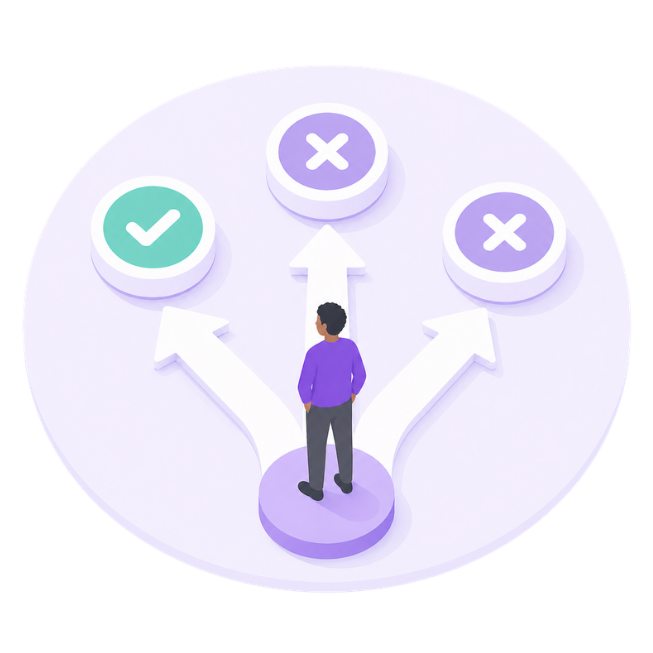
decide
This module trains teams in the techniques of making good decisions. Using scenario-based learning formats, teams are immersed in situations far removed from their daily work realities, but yet this helps them acquire skills quickly and for that learning to become second nature.
-
To develop structured decision-making capability under pressure and apply this to professional contexts
To strengthen leadership capability in situations involving uncertainty and competing priorities
To improve situational awareness and risk-based judgement in dynamic environments
To explore ethical decision-making and its organisational implications
To apply decision-making frameworks to workplace challenges
-
Greater clarity and consistency in how decisions are made across the team, particularly in situations involving uncertainty, time pressure or incomplete information.
Improved confidence in making and justifying decisions, with a shared understanding of the frameworks used to assess risk, options and consequences.
Stronger leadership under pressure, with individuals able to maintain focus, prioritise effectively and communicate decisions clearly.
A more deliberate approach to ethical judgement, with greater awareness of how decisions shape outcomes, accountability and organisational reputation.
Faster and more structured decision-making in day-to-day work, supported by practical models that can be applied immediately.
-
This module can be applied in a range of contexts where decision-making is a critical leadership capability, both at team and individual level. Examples include:
Operational leadership – supporting teams that need to make timely decisions under pressure, particularly where information is incomplete or evolving.
Change and transformation – enabling leadership teams to make clear, structured decisions when priorities compete and outcomes are uncertain.
Crisis and issue management – strengthening the ability to assess risk, select a course of action and communicate decisions in high-pressure situations.
Senior leadership teams – developing a consistent approach to decision-making, improving alignment and reducing ambiguity across functions.
Everyday management decisions – applying structured frameworks to routine decisions involving prioritisation, trade-offs and accountability.