

Case Study
Team Reset Programme for a specialist public sector team, Feb-Apr 2026
A cross-government team in a non-departmental public body used a well prepared one-day reset, supported by GC Index diagnostics, to build a clearer way of working under a changed stakeholder environment.
Helping a cross-government team to reset after significant change and to develop a more effective way of working with stakeholders
Client: a cross-government team at a non-departmental public body (confidential)
A specialist public sector team had been through a significant period of change. The team had reduced in size, its remit had evolved, and a new strategy was shaping both what it needed to deliver and how it needed to operate. While the team had adapted well, this was still a moment of transition, with a need to strengthen how delivery aligned with the new context in which the team was operating.
Recognising this as a moment to step back and reset, the team leader decided to invest in creating space for the team to reflect, strengthen cohesion and develop a clearer, more practical way of working for the next phase. Teamshaper was engaged to design and facilitate that process.
The programme was led by Teamshaper’s Associate Trainer Simon Phillips, a strategy and change specialist with experience in helping public sector teams translate change, ambiguity and strategic shift into clearer day-to-day ways of working.
Built upon the team’s context
The programme was shaped through several layers of preparation. This included consultation with the team leader, a review of the team’s strategy and a recent project they worked on, a confidential questionnaire completed by all team members to ascertain their own views of what’s working and what’s not, and GC Index diagnostics completed by all team members alongside a team snapshot view.
The GC Index is a psychometric diagnostic that measures the way someone is naturally inclined to make an impact in a work environment, helping us develop a bet…The GC Index is a psychometric diagnostic that measures the way someone is naturally inclined to make an impact in a work environment, helping us develop a better understanding of how the team actually operates, while also giving both the team leader and individual members a clear picture of how each person contributes, which served as a practical reference point for navigating new ways of working and reduced capacity following the restructure.
This level of access meant the session was designed around the team’s actual experience rather than surface assumptions. It also meant we could go beyond the more visible changes in team size and remit, and understand more clearly what was working well, where the key points of friction sat, and what would make the biggest difference.
The preparation revealed a team with strong internal relationships, a supportive culture and a clear sense of shared purpose. People valued what the team was there to do, enjoyed working with one another, and had maintained a strong sense of cohesion and commitment through a period of significant change.
The work highlighted that the team was now operating in a changed stakeholder environment, with a different pattern of engagement and less opportunity for timely dialogue and clarification than before. This had practical implications for the way work was scoped, how priorities were interpreted and how confidently the team could move from strategic steer into action. It also meant work had to be produced at greater pace.
The GC Index work added another essential layer to this picture. It showed a team with strong delivery energy, high standards, a collaborative instinct and a clear orientation towards producing useful outcomes. These insights helped build a clearer understanding of how the team was functioning at its best and how those strengths could be applied more deliberately in both internal coordination and stakeholder engagement.
This combination of inputs also clarified that the key issue was not simply how the team operated under ambiguity, but how its way of working with stakeholders worked in the new environment and influenced the level of clarity available.
Taken together, these insights shaped the focus of the session.
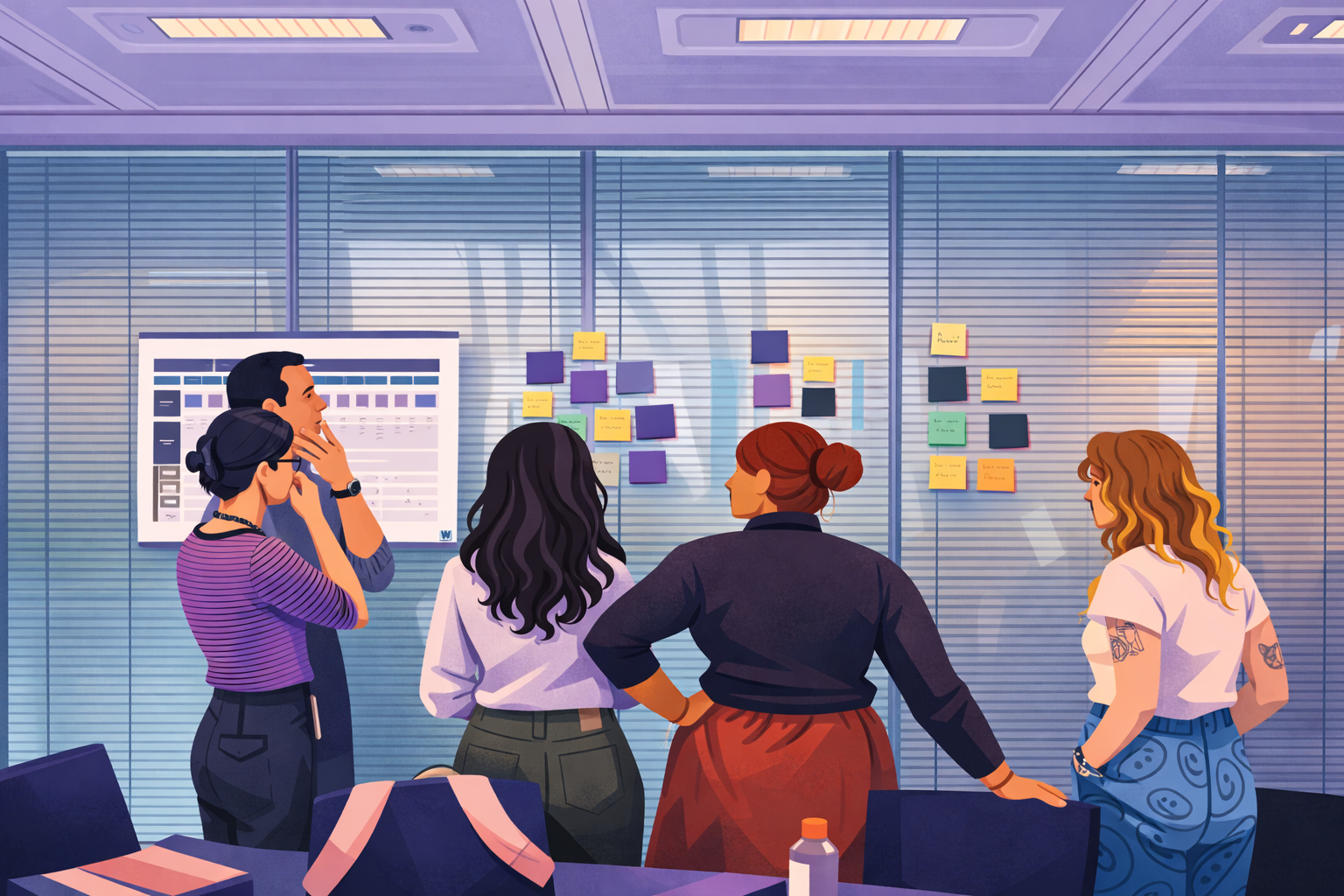
An experiential working session
The workshop was designed as a structured working day, built around the team’s real context and current priorities. The work focused on turning broad strategic direction into clear decisions, options and stakeholder-ready asks. With a small team, the work moved between individual reflection and whole-team discussion, ensuring both depth of thinking and shared alignment.
A central part of the day focused on working at pace under ambiguity, using an example to practise how broad strategic steer could be translated into clear questions, structured options and decision-ready outputs. This included defining the decision context, identifying the critical uncertainties that needed to be resolved, and shaping 2–3 practical options with clear trade-offs and a recommended way forward.
This provided the team with a more consistent and usable approach for progressing work when direction is partial or evolving, while also reinforcing how stakeholder engagement can be used to build clarity earlier in the process.
The session focused on clarifying priorities, strengthening coordination and agreeing practical ways of working that would support delivery in the coming months.
“Great reflection space and interesting insights translated into practical steps for the whole team”
“It was useful to have some time away and really think about the opportunities, barriers, and how to overcome difficult periods of change”
From clarity to action
By the end of the session, the team had developed:
a clearer shared view of what had changed and what that meant for delivery
a structured approach to working at pace under ambiguity, including how to define decisions, frame questions and develop options with trade-offs
a more precise understanding of how stakeholder engagement could evolve to support the team’s work more effectively
greater clarity on priorities, ownership and immediate next steps
a practical approach for translating strategic direction into structured action
stronger collective understanding of how the team’s strengths could be applied in the next phase of its work
The work created a more actionable basis for how clarity could be built into the team’s way of working, both internally and in its engagement with stakeholders, supporting more coordinated delivery and stronger outcomes.
Response from the team
The workshop was rated 4.6 out of 5 overall.
Feedback consistently reflected a session that felt highly relevant to the team’s situation. Participants described it as engaging, well-structured and very useful, and highlighted the value of having time to step back, reflect together and translate discussion into practical next steps.
“Helps to think more strategically about influence and prioritising work”
“I’d say it was extremely engaging, beautifully targeted, and devastatingly useful”
“Since the reset we have thought more strategically about wider stakeholder environments”
“The team has gotten a lot better at touching base with one another and making the most of each other’s expertise”
Sustaining momentum
A follow-up session was built into the programme and took place 5 weeks later. Its purpose was to review progress against commitments, understand what had changed in practice, and support the team in embedding the agreed ways of working.
This created a clear point of accountability and helped ensure that the session formed part of an ongoing process of change, with a continued focus on applying the work in day-to-day activity.
At the follow-up, the team was able to point to specific examples of how these approaches were being applied in practice, including clearer structuring of work, more deliberate stakeholder engagement and greater clarity on priorities, ownership and next steps. This reinforced the agreed ways of working and helped embed them in day-to-day delivery.
What this demonstrates
This case shows what can happen when a team leader invests thoughtfully in her team at a moment of change.
By opening up the team’s context, sharing real examples, enabling confidential input from team members and supporting the use of diagnostics, she created the conditions for a level of transparency that allowed the work to address how the team was operating in practice.
The team itself brought strong cohesion, a clear sense of purpose and a high level of commitment to its work. The opportunity was to build on those strengths by refining how the team engaged with stakeholders and how clarity was created within that interaction.
The combination of tailored preparation, confidential team insight, GC Index diagnostics, a live case-based working session and structured follow-up created a practical foundation for the team to move forward with greater clarity, stronger ownership and an approach to stakeholder engagement that better reflects its current context.
Find out what this programme would look like when adapted to your team’s context
“Really helpful, targeted training that felt very relevant to the challenges of my specific team”